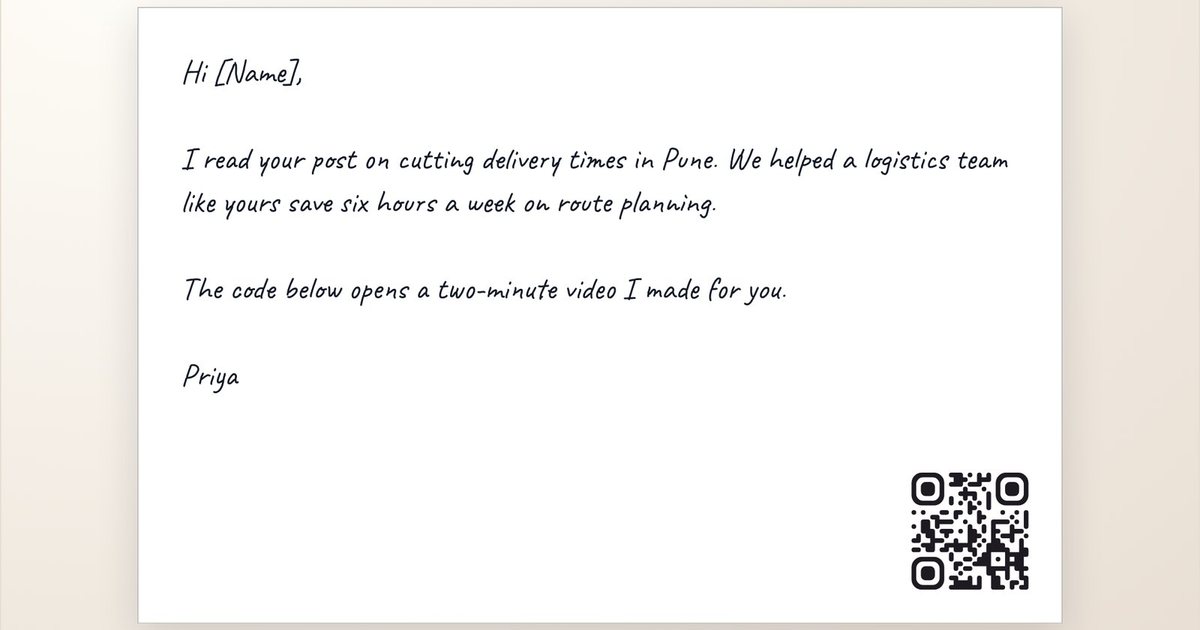
Cold email is not dead, but it is crowded. Almost every outbound team I talk to runs the same stack: the same sequencing tool, the same warmed-up domains, the same AI-written first line that mentions your latest LinkedIn post. When everyone can send a thousand "personalised" emails a day, a personalised email stops being a sign that anyone made an effort.
A handwritten postcard is the opposite. It is rare, it is physical, and it is hard to fake at scale. Sent to a short list of accounts you really want, with a QR code that tells you when it was scanned, it is one of the few outbound moves left where the effort is visible to the person receiving it.
Is cold email dead in 2026?
No, but the easy, high-volume version of it is. Three things changed.
The inbox providers drew hard lines. Google's sender guidelines say that "starting February 1, 2024, email senders who send more than 5,000 messages per day to Gmail accounts must meet the requirements" it lists, one-click unsubscribe included. On complaints, it asks senders to "keep spam rates reported in Postmaster Tools below 0.10% and avoid ever reaching a spam rate of 0.30% or higher" (Google). Yahoo enforces the same 0.3% line (Yahoo Sender Hub). Three complaints per thousand emails and your domain is in trouble.
Opens stopped meaning anything. Since 2021, Apple's Mail Privacy Protection "stops senders from using invisible pixels to collect information about the user" and "helps users prevent senders from knowing when they open an email" (Apple Newsroom). A lot of the "opens" in your dashboard are Apple's servers, not people. The metric most sequences were tuned on is noise.
Everyone has the same machine. Data providers, sequencers and AI writers are cheap. That is good for senders and bad for being noticed: your best prospect gets the same clever opener from many vendors a week.
Why does a handwritten postcard get noticed?
Because almost nobody sends personal mail any more. In 2024 the average US household received 3.4 personal letters or invitations in the whole year, down from 8.4 in 2014, and households read 26% of advertising mail even from companies they had never bought from (USPS Household Diary Study, FY 2024). And a personal handwritten request moves people: in a 2013 randomised trial by Ireland's Revenue Commissioners, 36% of businesses that got a handwritten sticky note replied within 15 working days, against 19.2% of those that did not (Behavioural Insights Team).
I want to be straight about the limits. Cold mail to strangers still averages around a 1% response across UK campaigns (JICMAIL), and no large study isolates handwritten sales postcards. The evidence supports something narrower: a short, specific, handwritten note to someone who matters to you is more likely to be read and answered than one more email. That is the bet.
How direct mail is changing in 2026 and 2027
Direct mail used to mean a print run, a mailing house and weeks of lead time. The slow parts are now software:
- Mail fires from a trigger. A card can go out when a deal hits a CRM stage, a row lands in a Google Sheet, or a payment succeeds.
- Every card can carry a real detail. Fields like
[Name]and[Company]fill from your list, so a hundred cards can each say something only that person would recognise. - A pen writes it, not a printer. Handwriting machines move a real pen across the card, so the ink sits in the paper the way a hand leaves it.
- Paper links to the screen. A printed QR code turns a postcard into a door to a video, a booking page or a case study, and the scan tells you it worked.
- AI agents can send mail. Through an API or an MCP server, an assistant can prepare a card for a human to approve.
For outbound, that means you can do for twenty key accounts what used to need an agency, from the tools you already use for email.
A read receipt for paper: the QR code
You can't know a card was read, just as you never really could with email. But a QR code gives you a signal email has lost: someone held the card and scanned it.
On MailMyCard each code opens a page you control. Once the card is ordered, the page counts every scan and lists when it happened, on what kind of device and in which country.
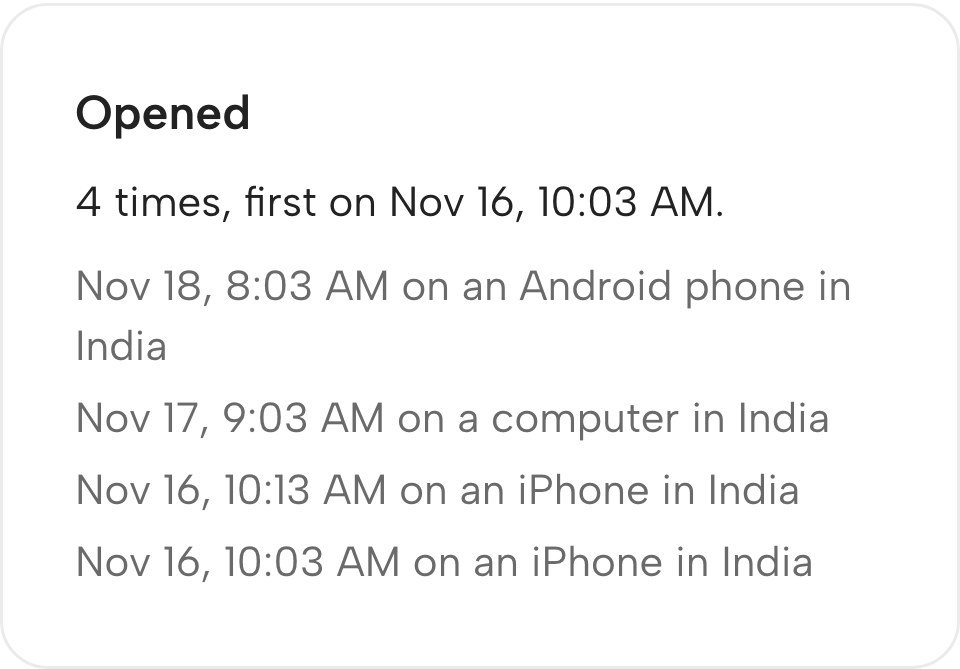
What the count does and doesn't tell you:
- A scan is a device, not a person. An assistant may scan it for their boss. Treat it as a strong hint, not proof.
- Your own scans and link-preview bots don't count, so setting the page up doesn't pollute the log.
- No IP address is stored, only the device type and country. Useful to you without tracking the recipient.
How to send a handwritten outreach postcard, step by step
About five minutes for the first card; after that it's a template.
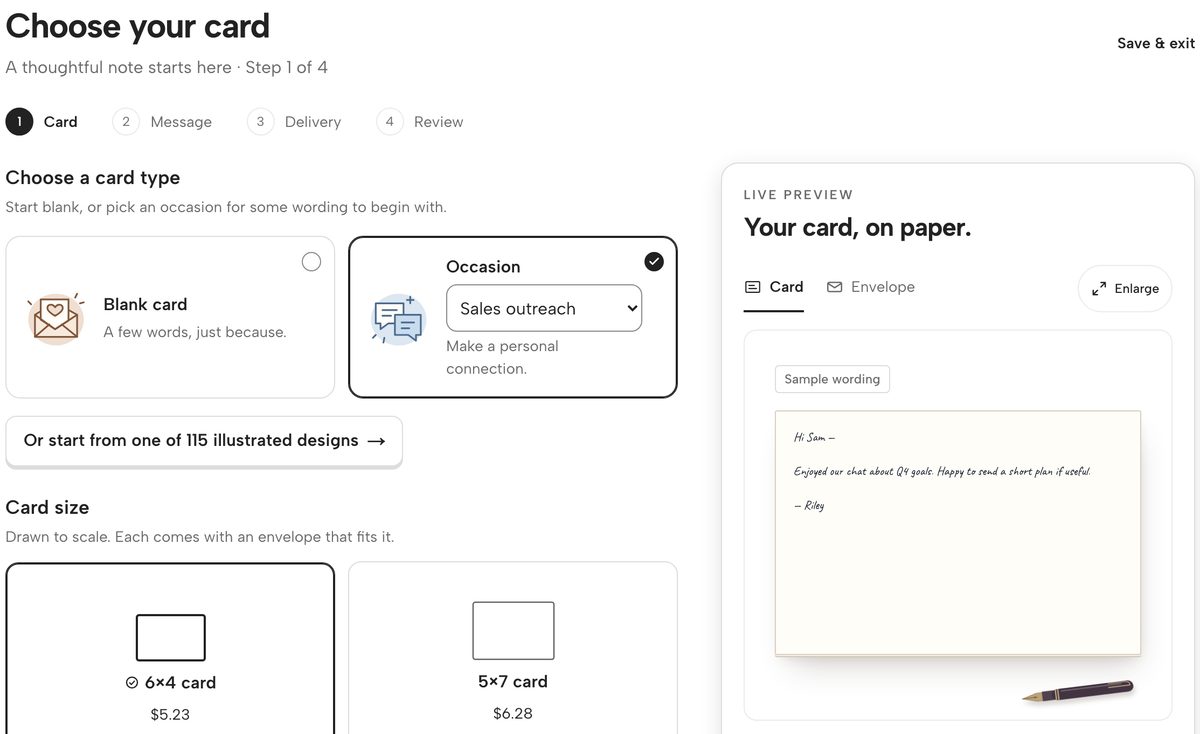
1. Choose the card and its size
Start a card on mailmycard.com and pick Sales outreach as the occasion. Choose a 6×4 card or a 5×7 card with about half as much room again. Both come with a matching envelope, in black ink.
2. Write the message
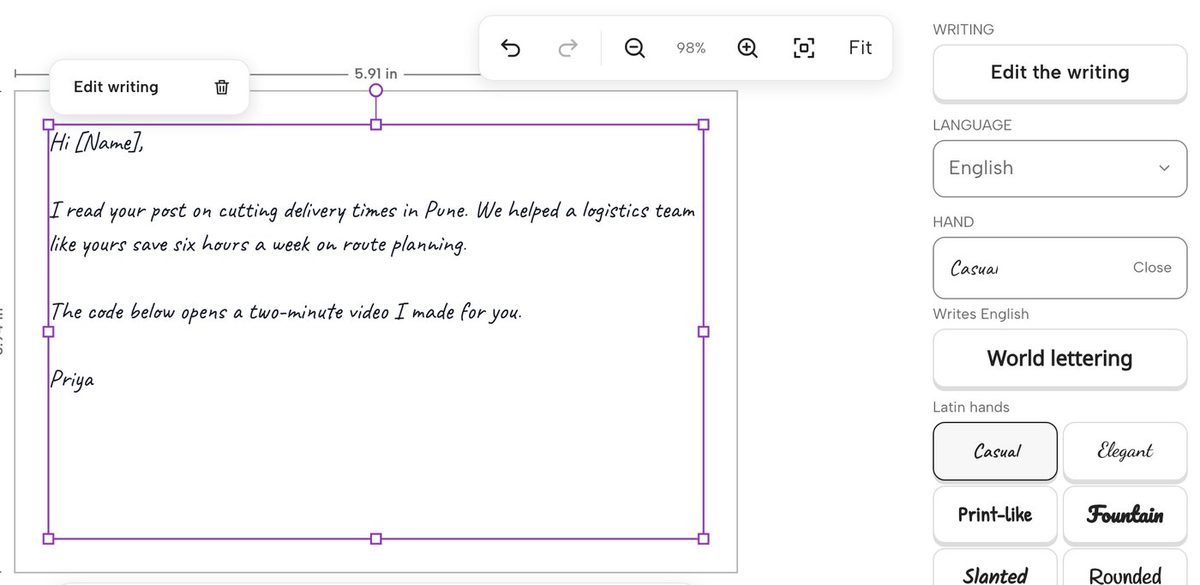
Click the card and type. Four or five lines: who you are, one detail that proves you looked at
their business, and one next step. Put [Name] where the first name goes and it fills
in per recipient when you send to a list. If your text has to shrink to fit, the editor tells you.
3. Pick the handwriting
Each style is shown in its own letters: Casual, Elegant, Print-like, Fountain and more, plus 178 further pen hands. Or set up your own handwriting from a photographed sample sheet, and the pen writes in your hand.
4. Add a QR code
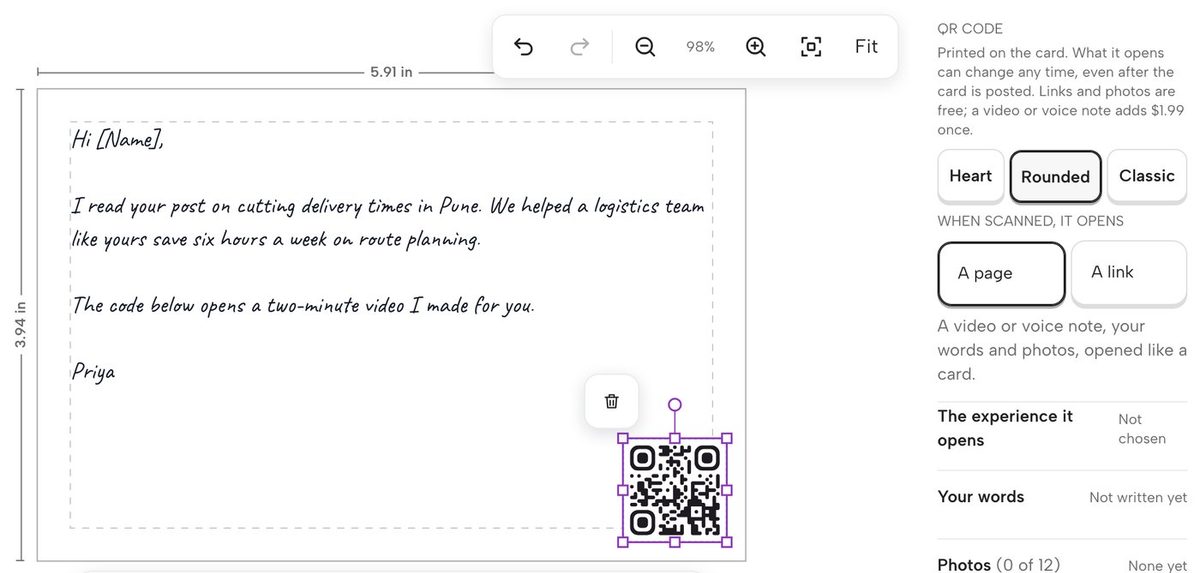
Choose QR code from the bar under the card, pick a style (Rounded or Classic for business), and choose what it opens:
- A page that opens like a card, with a short video or voice note recorded for this prospect, a few words and up to 12 photos.
- A link to your calendar, a case study or a proposal.
The printed code never changes, but what it opens can, even after the card is posted. Record the video the night before it lands if you like.
5. Address it, check it, send it
Add the address (or upload a list), review the card exactly as it will be written, and send. A real pen writes it, and it is posted from Bangalore by Speed Post within 3 business days, then typically 3 to 7 days in transit within India and abroad. Once it is out, watch the card's QR page. The first scan is your cue to follow up with something better than "just bumping this up".
What should an outreach postcard say?
Short, specific and about them. Three made-up examples to adapt:
Hi Ananya, I saw Lakeside opened its third clinic in October. We run patient reminders for clinics in Pune, and the code opens a two-minute video of how it would work for yours. Rohan
Dear Mr Fernandes, your talk on cold-chain losses at the Mumbai logistics meet stayed with me. We track temperature across truck fleets and I'd like to show you what we see. The code opens my calendar. Kavya
Hi Sam, congratulations on the Series A. When you start hiring reps next quarter, we can have their laptops ready on day one. A short case study is behind the code. Leo
Only claim results you can back up. A postcard with an inflated number is worse than no postcard.
Cold email vs a handwritten postcard
| Cold email | Handwritten postcard | |
|---|---|---|
| Cost per touch | Close to nothing | About $5.20 (6×4) or $6.30 (5×7) a card on MailMyCard, plus delivery |
| Speed | Seconds | Posted within 3 business days, then 3 to 7 days |
| Volume | Thousands a day, within provider limits | Tens to hundreds of chosen accounts |
| What you can measure | Replies and clicks; opens unreliable | QR scans, then replies |
| Risk | Spam complaints hurt your domain | No spam folder to land in |
| What it signals | Often read as automated | Visible effort and a physical object |
Prices are MailMyCard's on 18 November 2026; they are set in rupees, so the dollar figure moves a little with the exchange rate. Teams sending 50 or more cards get volume pricing on the business page.
When a postcard is the wrong tool
- You need an answer this week. Mail takes days. Use it to open a conversation, not to chase a deadline.
- Your list is thousands of strangers. At card prices it pays off on high-value accounts, not a broad list where 1% response is normal.
- You have nothing specific to say. A generic pitch in handwriting is still a generic pitch, now at five dollars.
- You only have a home address you were never given. Send to the office.
The bottom line
Cold email isn't dead; it's just no longer a way to stand out. Use it for reach, and use a handwritten postcard with a QR code for the handful of accounts where being remembered is the whole game. If you are weighing providers, I compared four handwritten notes services here if you want to weigh the alternatives.
Comments
Have thoughts on this post? Join the discussion below! Comments are powered by Disqus.