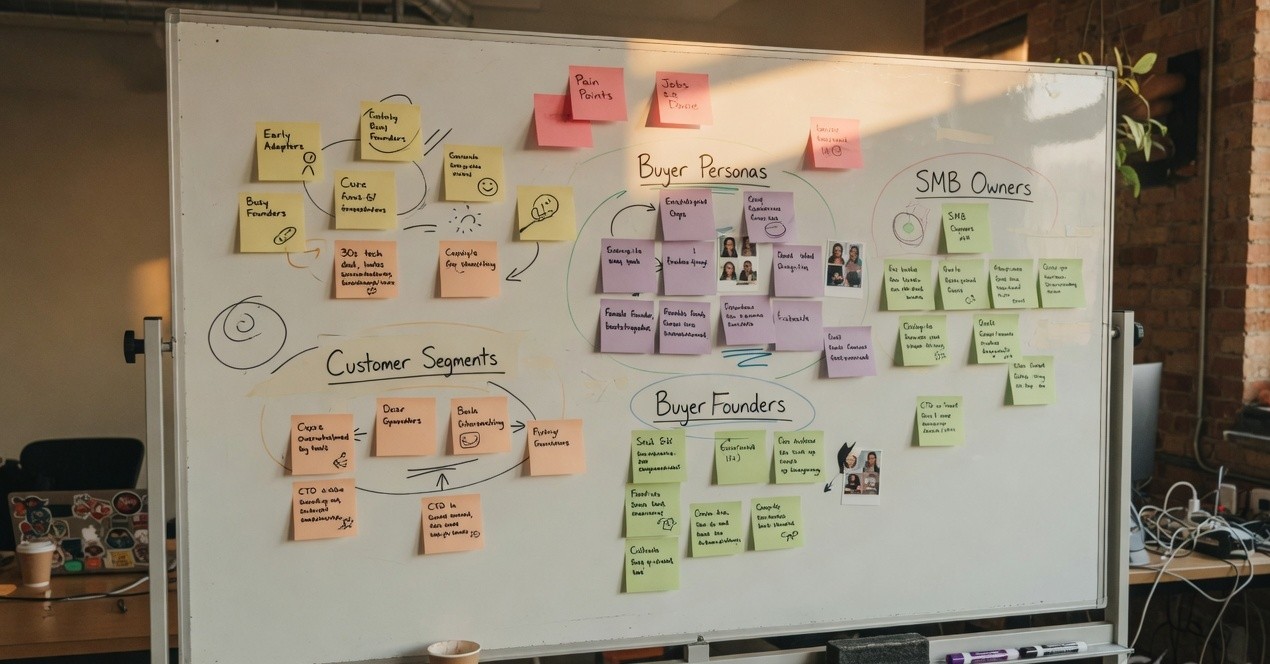
Most Ideal Customer Profiles are fiction. A founder opens a Notion doc, lists an industry, a headcount band, and a job title that feels plausible, then spends the next six months wondering why pipeline is soft and demos go nowhere.
The doc was never the problem. The process was. An ICP is not a brainstorming artifact. It is a claim about who will buy, expand, and stick — and claims need evidence.
I've watched this play out on both sides: building products for home-services companies at Avoca, and selling a tool (QRCodeStack) into a messier SMB market than the one I first imagined. Getting ICP right is less about filling a template and more about refusing to confuse interest with fit. What follows is the version I wish someone had handed me earlier — synthesised from the better guides out there and the mistakes that keep repeating.
ICP Is a Company, Not a Cartoon
An Ideal Customer Profile describes the company most likely to become a great customer. A buyer persona describes the person inside that company who feels the pain and champions the deal. Conflating the two is how you end up with "Sarah, 34, drinks oat milk, reads HBR" documents that never change a single outreach sequence.
A usable ICP answers questions like:
- What industry and business model? (B2B vs B2C, agency vs product company, franchise vs independent.)
- What size — employees, revenue band, team size of the department you sell into?
- Where are they, and can you actually support them after the sale?
- What tech stack or workflow are they already in?
- What trigger makes the pain acute enough to buy now?
- What economics make this a good customer — deal size, sales cycle, expansion path, churn risk?
If you cannot point to a real company and say "that one, not that one," you do not have an ICP. You have a mood board.
Why Most ICP Discovery Fails Before It Starts
EarlyCustomers' ICP finding guide nails the three failure modes almost every early team falls into:
- They guess from their own biography. "I used to be a marketing manager, so marketing managers are my ICP." Maybe. Or maybe former peers are the ones least willing to pay for a problem they already hacked around.
- They copy a competitor's apparent audience. Competitors often started wrong too — and spent years iterating off-camera. Their homepage is not a map of truth.
- They survey their network. Friends are polite. Your LinkedIn is biased toward people like you. Neither group is a random sample of buyers.
All three share one flaw: they privilege what people say in a hypothetical over what people do when the pain is live. The internet is full of the second kind of signal — Reddit threads, LinkedIn posts, competitor reviews, "switching from X" complaints. That is where discovery starts if you are willing to listen before you pitch.
Start Narrow: Hypotheses, Then a Beachhead
For startups, perfection is the enemy. Tario's startup ICP playbook has the right posture: treat your first ICP like an MVP. Write 2–3 hypotheses, not one sacred truth.
Example shape:
- Hypothesis A: mid-market SaaS companies, 50–200 employees, VP Sales as buyer.
- Hypothesis B: agencies with 10–40 people who live in spreadsheets.
- Hypothesis C: retail brands running paid acquisition and bleeding attribution.
Then pick a beachhead — the one segment you will dominate first. Sparksense's four-step framing is useful here: target audience → potential market → decision-maker persona → beachhead. Startups cannot afford to chase every plausible ICP at once. Concentration buys references, case studies, and a sales motion that compounds. Diffusion buys calendar noise.
Play-Doh started as a wallpaper cleaner. The product found a better customer. Your beachhead is permission to learn that lesson on purpose instead of by accident.
A Practical Process That Survives Contact With Reality
1. Mine early adopters, not imaginary buyers
Your first pilots, beta users, and paying customers are the dataset. Look for shared pain, shared triggers, shared budgets, and shared definitions of success. The people who pay and refer are usually a better ICP seed than the people who buy fastest and ghost after month two.
2. Collect language from conversations
Discovery calls are research before they are sales. Useful questions:
- What triggered you to look for a solution now?
- What have you already tried, and why did it fail?
- Walk me through a bad week with this problem.
- Who else has to say yes for this to happen?
- If this were solved tomorrow, what would be different?
Write down their words. Marketing copy written in the customer's vocabulary converts; copy written in your deck vocabulary does not. Run at least ten of these before you rewrite the ICP based on one contradictory call. One outlier is noise. Ten patterns are a signal.
3. Layer quantitative validation
Qualitative insight without numbers is storytelling. Pull win rates, deal size, cycle length, expansion, and churn by segment. The segment that closes fast but churns in ninety days is not your ICP — it is a trap that flatters your ego and hollows your revenue.
Score accounts against a short checklist: firmographic fit, trigger present, budget credible, champion identified, path to value clear. If half your pipeline fails the checklist, your top-of-funnel is lying to you.
4. Match "find" tools to the ICP you actually have
Defining an ICP and assembling a list of those companies are different jobs. Origami's 2026 ICP guide makes a point worth repeating: enterprise SaaS buyers live in LinkedIn-shaped databases; HVAC owners and niche Shopify operators often do not. If your ICP is local services or a platform-specific niche, a ZoomInfo-shaped workflow will miss most of the market and you will blame "messaging" for a coverage problem.
Be specific when you search. "Small businesses" is not a prompt. "HVAC contractors in Texas with 10–50 employees and 5+ years in business" is. Vague ICPs produce vague lists, which produce vague outreach, which produce silence you then over-interpret.
5. Document something short enough to use
One page. Industry, size, geography, tech/workflow context, trigger events, disqualifiers, primary persona by company size, and 3–5 example accounts. Share it with sales, marketing, and product. If it cannot survive a Friday afternoon skim, nobody will use it on Monday morning.
The Disqualifiers Matter More Than the Ideal
Teams love describing who they want. They under-invest in who they will refuse. Good ICPs have sharp negative space:
- Companies below a minimum size if your product needs a workflow owner.
- Segments that need heavy custom work you cannot support yet.
- Buyers who want a feature that fights your roadmap.
- Geographies you cannot service without burning margin.
- "Logo" accounts that look great on a slide and terrible in a support queue.
Saying no is how ICP becomes an operating system instead of a vision statement.
Common Mistakes That Keep ICPs Fake
- One-and-done. Contact data decays. Companies change stage. Job titles rotate. Refresh quarterly, or your "ideal" list becomes a cemetery of old titles.
- Enterprise tools for SMB realities. Wrong data source, wrong coverage, wrong conclusions.
- Confusing curiosity with intent. "Anyone have CRM thoughts?" is not the same signal as "we're leaving HubSpot in three weeks, what do small teams use?"
- Optimising for who buys fastest. Speed without retention is a leaky bucket with a nice dashboard.
- Skipping the buying committee. Your champion is not always your economic buyer. Map both, especially as deal size grows.
How You Know You've Got It Right
Skip the vibe check. Look for operational evidence:
- Win rate in-ICP is clearly higher than out-of-ICP.
- Sales cycle is shorter and more predictable inside the beachhead.
- Customers expand or refer without heroic white-glove work.
- Product, marketing, and sales argue less about "who we're for."
- You can explain, in one sentence, why a specific account is a bad fit — and the team agrees.
When those are true, the Notion doc finally earns its keep. Until then, keep treating the ICP as a hypothesis under test, not a brand identity.
A Closing Rule
Get ICP right by discovering it from behaviour — early buyers, public pain posts, win/loss patterns — then ruthlessly concentrating on a beachhead until you have proof. Widen later. The founders who lose years are rarely the ones who picked a slightly wrong segment. They are the ones who refused to pick, and spent the runway selling to everyone a little bit.
Write the one-pager. Run the ten calls. Score the pipeline. Update the doc when reality disagrees. That loop is the whole game.
Working out who a product is for is the first step of any AI consulting engagement I take on.
Further reading that informed this post: EarlyCustomers ICP Finding Guide, How to Find Your ICP in 2026 (Origami), Sparksense's 4-step Ideal Customer, and Tario on ICP development for startups.
Comments
Have thoughts on this post? Join the discussion below! Comments are powered by Disqus.